

Hey, what happened to our pumpkin?
My husband and I found chunks of pumpkin and seeds scattered across our deck. Someone had been enjoying a fall feast.
That same day, we found our answer: a squirrel.
Mystery solved. I even took pictures of him in action, enjoying his snack.
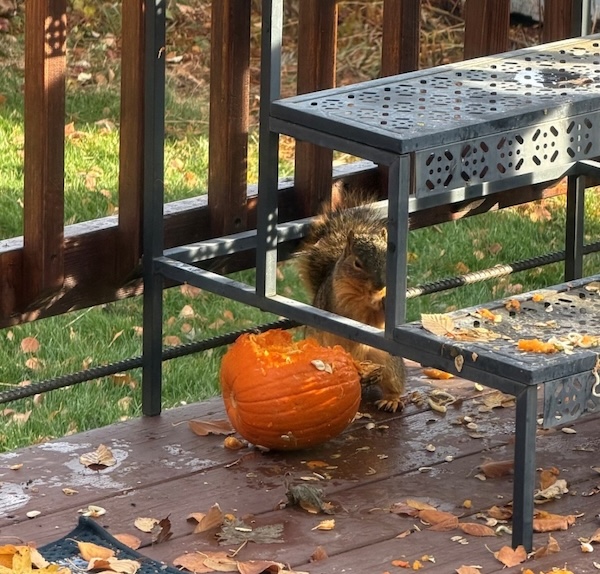
Our squirrel was eating on the spot, but squirrels are better known for stashing food in the fall so it’s there when they need it. A/E/C firms could take a lesson from them, especially when a team is preparing for a client selection interview.
In your brainstorming session, participants ask, “What story would help this client understand how we could solve their problem?”
Your firm may have a related project. But can anyone find the details that would turn that experience into a compelling story?
Two Firms. One Question
Imagine two firms preparing for a client interview for a road improvement project. The prospective client is concerned about maintaining access to local businesses during construction.
Both firms have handled similar challenges. Both have qualified teams. Both want to demonstrate that they understand what’s at stake.
Their preparation, however, looks different.
Firm A starts asking around.
“Didn’t we work on a project with a difficult traffic staging problem?”
Someone remembers one. Someone else suggests talking with the project manager, who is busy with another deadline.
The team finds a project description, but it mostly covers scope and technical services. What made the staging difficult? How did the team address business owners’ concerns? What happened as a result?
There isn’t much information.
The team has relevant experience, but it struggles to tell a story that shows why that experience matters to this client.
Firm B goes to its story stash.
A search turns up a transcript of a debrief with the project manager. It captures the access challenges, the options considered, and how the team developed its staging approach.
There are details about communicating with business owners and adjusting plans in response to their concerns. There’s even an approved client testimonial describing the difference the team made.
Gold!
Now the interview team has material it can shape into a concise, relevant story. It can explain the challenge, the decisions, and the results—and connect those details to the prospective client’s concerns.
Capture the Details Before You Need Them
Firm B’s advantage began well before the interview invitation arrived.
Someone took time to ask questions, capture the answers, and save them where others could find them.
Your firm can do the same. Conversations with project managers and clients can uncover details that rarely make it into a standard project description:
- What was the client’s biggest concern, and what made it challenging?
- How did your team address it, and why did you choose that approach?
- What were the results, and what did the client value most?
A story about successful public information meetings might help a team pursuing a project with concerned neighbors. A traffic staging story might reassure a client worried about disruption to businesses.
Save each story in the project file, with challenges identified so your team can search for it later. Include the transcript, verified results, photos, and any approved testimonials.
Capturing the details gives your team something useful to draw from when you face an important client interview.
Know the Whole Story
As for our pumpkin, we know the squirrel was the guilty party. At least he’s fueling up for winter.
It’s always better to know the whole story.
And when your next client interview is approaching, it’s even better to know exactly where your stories are stashed.
Could your team find a relevant project story today, with the details and client perspective to support it?
If you want to learn more about storytelling, case studies and other communications for A/E/C industries? A/E/C Connect is my newsletter. Subscribe on LinkedIn to be the first to see each new entry. If you have a challenge or question you would like me to address, contact me at blaizecommunications@gmail.com.